
Anderson Projected Versus Actual Release
TDCJ defines Projected Release Date as the date calculated by CID Classification and Records on which a prisoner is projected to leave incarceration if not paroled sooner. Offense title, offense date, sentence data, calendar time, good-conduct time treatment, mandatory-supervision eligibility, and Board action can affect it. The field is prospective. It does not prove that the person passed through the gate.
A Scheduled Release Date is a later operational date produced after favorable action, release-plan review, and a records audit. An actual release or discharge is historical. Discharge is the stronger sentence-completion term because release from prison on parole can leave years of supervision. Anderson County Jail has a separate local system. A bond release, court order, time-served judgment, or transfer cannot be calculated from a TDCJ projection.
| Label | Meaning | Best source |
|---|---|---|
| Projected Release Date | Changeable TDCJ calculation | Current TDCJ detail or information request |
| Scheduled Release Date | Operational date after favorable action and audit | TDCJ release processing |
| Actual county release | Booking-out event | ACSO release record |
| Discharge | Sentence or supervision completion | TDCJ or court record |
Find Anderson TDCJ Release Dates
The TDCJ Online Inmate Search accepts an exact last name plus at least a first initial, or a seven-digit TDCJ number, or SID number. Gender and race can narrow a name search. Compare the conviction and identifiers before relying on a match. The database contains only people currently incarcerated in TDCJ, updates on working days, and is at least 24 hours old.
- Choose TDCJ only if the person is in state custody, including a transfer from Anderson County Jail.
- Search by TDCJ or SID number when possible. Otherwise use the exact name fields.
- Open the matching detail and copy the field label, access date, location, offense, and Projected Release Date.
- Read parole-review and release-planning fields separately. They do not mean the person has left.
- Confirm a favorable action with TDCJ release processing before treating any date as scheduled.
The official Review and Release Processing page describes checks that follow a favorable decision.
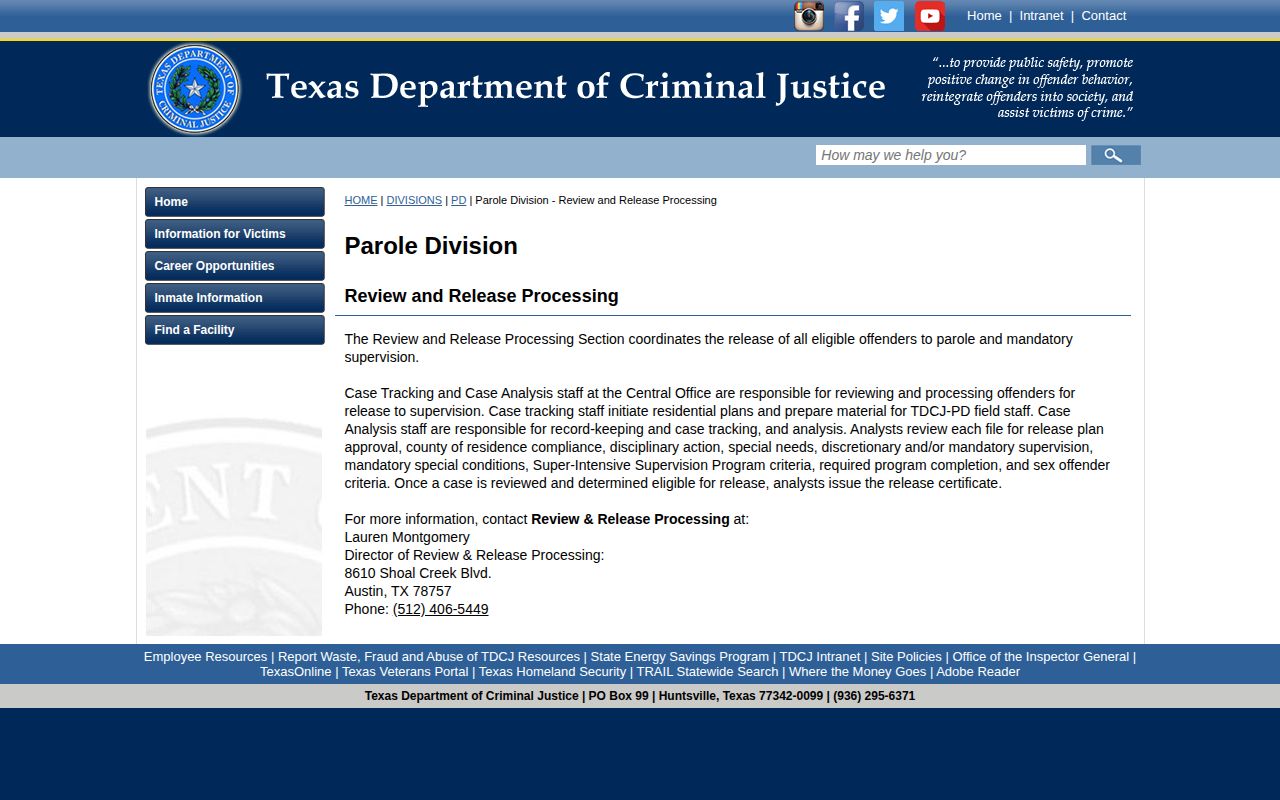
Those checks explain why approval, projection, scheduling, and departure may fall on different dates.
Former Anderson TDCJ Prisoners
A former Texas prisoner does not retain a public Released or Discharged profile in the current locator. A no-result can reflect release, an exact-name mismatch, a delay, sealed or expunged material, or another issue. For history, email TDCJ inmate information at pia@tdcj.texas.gov. Give full name and TDCJ number. If the number is unknown, provide exact birth date, or approximate age and county of conviction.
TDCJ lists the channel as free and may return the TDCJ number, location, conviction information, prior incarceration history, and projected date. It does not provide photographs through that email product. Pair the response with the conviction judgment and any discharge record. The broader released-person workflow is available through the Anderson County released-inmate search.
Read Anderson TDCJ Date Fields
A date search is strongest when the field inventory is preserved. Record the exact label rather than rewriting every date as “release date.” The current result may include location, offense, Projected Release Date, and parole-review or release-planning information. A favorable action may later add Scheduled Release Date and Scheduled Release Location while the prisoner remains incarcerated.
| Field to capture | Why it matters |
|---|---|
| TDCJ or SID number | Separates people with similar names |
| Assigned location | Shows the current state custodian |
| Offense and county | Helps match the correct judgment |
| Projected Release Date | Preserves the prospective calculation |
| Board or release-planning field | Shows the stage without proving departure |
| Access date | Documents when a changeable result was viewed |
If two official records show different dates, compare their labels and creation times before calling either one wrong. A court judgment states the sentence. TDCJ applies classification and statutory rules. A Board result records a decision. The final booking-out or discharge record documents a later event. Each source can be accurate about a different step.
Texas Good Time for Anderson Records
Government Code Chapter 498 governs good-conduct time. Section 498.003 addresses classification and accrual, section 498.004 addresses forfeiture and restoration, and section 498.005 states that good time is a privilege rather than a right and does not reduce sentence length. Good time can affect parole or mandatory-supervision eligibility when the governing law permits it. It is wrong to subtract one calendar day from the sentence for each credited day.
Texas has no universal rule that every prisoner serves 85 percent. Calculations depend on the offense, offense date, sentence structure, calendar time, eligibility category, Board action, and TDCJ data. Concurrent and consecutive sentences also matter. No public page should compute an individual date from a generic percentage.
- Flat time
- Actual calendar time served.
- Good-conduct time
- A classification-based credit that affects eligibility as statute allows but does not shorten the sentence itself.
- Maximum expiration
- The endpoint reached when the sentence runs to its governing maximum.
- Parole eligibility
- The point when Board consideration may occur, not a promised release date.
Anderson Mandatory Supervision Dates
TDCJ describes three broad projection patterns. For an eligible offense committed before September 1, 1996, the projected date may be when flat time plus good time equals the sentence, unless parole occurs first. For an eligible offense on or after that date, reaching the arithmetic point is subject to Board approval of discretionary mandatory supervision. A denial can shift the projection to maximum expiration; later approval can shift it earlier.
For an offense excluded from mandatory supervision, the projection generally follows maximum expiration based on flat time unless parole intervenes. Government Code Chapter 508 contains the parole and mandatory-supervision rules, including excluded categories. Eligibility permits a decision process. It is not release authorization.
The statute is the source for the distinction.
Read the applicable provisions with the offense date and judgment rather than applying a single formula.
Anderson Aggravated-Offense Date Rules
Section 508.145 contains offense-specific parole eligibility. Categories tied to Code of Criminal Procedure Article 42A.054 often require actual calendar time, without good-time credit, equal to one-half the sentence or 30 calendar years, whichever is less, with statutory minimums and exceptions. That is not an 85-percent rule, and other offense provisions differ.
The Article 42A provisions identify aggravated categories relevant to the eligibility analysis.
Only the controlling judgment, offense date, statutes, and TDCJ calculation can resolve an individual record.
Why Anderson Release Dates Change
A projection is recalculated as the controlling inputs change. Some changes arise from the prison record. Others follow a Board decision or court correction. The final audit can uncover sentence-data issues that were not visible to a search user.
| Factor | Possible effect | Where to confirm |
|---|---|---|
| Good-time accrual or forfeiture | Changes an eligible calculation | TDCJ Classification and Records |
| Disciplinary action | Can affect classification or favorable action | TDCJ record |
| Mandatory-supervision denial | May move projection to maximum expiration | Board result and TDCJ detail |
| Later approval or parole action | May move departure earlier | Board and release processing |
| Program or special condition | Can delay scheduling | Release certificate and TDCJ status |
| Sentence-data correction | Can change multiple date fields | Judgment and final records audit |
A detainer or transfer order can also change where a person goes. Leaving one unit for another remains incarceration. A person leaving an Anderson County TDCJ unit under another authority's hold has not necessarily entered the community.
When Anderson Scheduling Follows Approval
After a favorable parole vote, Review and Release Processing checks the proposed plan, county-of-residence rules, programs, disciplinary issues, special conditions, and other statutory criteria. Classification and Records then audits the case and calculates the Scheduled Release Date and Scheduled Release Location. TDCJ's ombudsman estimates roughly 14 to 21 business days after receipt of a release certificate for this stage, while warning that the date may change, even on the scheduled day.
This sequence is Anderson County's distinctive release-date issue because five TDCJ units sit locally. A favorable vote for a person at Beto, Coffield, Gurney, Michael, or Powledge is not proof of departure from that unit. The TDCJ definitions and ombudsman parole FAQ distinguish projection from later scheduling.
Note: Gurney is a transfer facility, so movement away from it may be another TDCJ placement rather than community release.
Anderson County Jail Dates
Do not apply the state formula to Anderson County Jail. For a sentenced county detainee, obtain the judgment, jail-credit calculation, booking record, and any release order. For a pretrial detainee, review bond and court orders. ACSO records can establish the booking-out date and release type, while the court record explains the legal basis.
No Anderson-specific county good-time or weekend-release policy was located. The county also publishes no release-processing hour or recent-release feed. Ask ACSO at 903-729-6068 about the specific booking, and request existing records rather than asking staff to calculate a date that the agency has not recorded.
Anderson Transfers Are Not Release
Anderson County contains five TDCJ facilities, so a location change may be especially easy to misread. Beto, Coffield, Michael, and Powledge are state prisons. Gurney is a reception and transfer facility. Movement from Gurney to another TDCJ unit closes one placement but does not end incarceration. Likewise, transfer from ACSO to TDCJ ends the county booking while state custody begins.
Ask the departing custodian for the receiving agency or location. Then confirm admission in the next system. If another county, federal authority, or ICE receives the person, follow that named authority instead of treating the Anderson booking-out time as a community release. The chain of records should show departure, destination, receiving event, and any later actual release.
Confirm Anderson Actual Release
Before relying on a projected date, check whether the source still labels it projected. Look for a separate scheduled date only after favorable action. On or after that date, confirm with TDCJ or ACSO rather than assuming departure. If supervision follows, the parole or probation record explains the next legal status.
Texas IVSS can provide notifications for qualifying state prison or parole events, but it is not a certified release record. Use the alert for timing and obtain the official history, release certificate, discharge information, or booking-out record for proof. Keep the alert's event label and time because a transfer notice can otherwise be mistaken for a community release. Final proof should name the releasing authority and actual disposition.