
No Anderson County 72-Hour List
The Anderson County Sheriff's Office publishes jail rules and contact material, but no official roster, released-person filter, or rolling three-day report. It also has no verified local jail app with such a feature. That means no official online cadence, retention span, list fields, or release-photo policy exists to quote. A private directory or current-custody search must not be relabeled as the county's 72-hour list.
Check Three Days of Anderson Releases
Define the period before contacting ACSO. Use exact inclusive timestamps, such as the beginning of day one through the end of day three, rather than “recently” or “over the weekend.” The sheriff's main office and jail are at 1200 E. Lacy Street, Palestine, TX 75801, telephone 903-729-6068 and fax 903-729-3022.
- List the start and end date and time for the three-day window.
- If checking one person, add the full name, booking number, and arrest date.
- Ask whether an existing booking-out report or export covers that interval.
- Request the release type, authority, and transfer destination with every matching entry.
- Match each record to the relevant court cause or receiving agency.
- Preserve the agency response and access date as the historical evidence.
Use the 24-Hour Release List process when only today's activity matters.
What a Three-Day Release Export Should Show
Ask for the fields already maintained in ACSO records, not for staff to create new analytics. Protected information may be redacted, and requesting segregable public portions can avoid an all-or-nothing response.
| Requested field | Reason to include it |
|---|---|
| Name and booking number | Separates one admission from another and reduces false matches. |
| Booking-in date and time | Provides the start of the local custody episode. |
| Booking-out date and time | Tests whether the event falls inside the exact 72-hour range. |
| Release authority or type | Explains the recorded reason the booking ended. |
| Bond information | Connects a bond release to its terms without implying case dismissal. |
| Receiving agency or destination | Identifies a transfer and prevents a false community-release claim. |
| Court or order reference | Points to the legal document that should be retrieved from the clerk. |
Weekend Anderson County Release Checks
No reviewed county source publishes a weekend release schedule, holiday procedure, public exit, family waiting area, or feed-delay rule. Do not import those details from another Texas jail. A three-day request is useful because it gives a fixed documentary range around a weekend, not because ACSO promises a special Monday update.
If the period crosses a holiday, state every calendar date and timestamp. Ask for booking-out records rather than a “weekend list,” since the latter may not be an existing county product. If the agency needs clarification, respond with the narrow range, names, and booking identifiers. Volume, clarification, cost estimates, and legal exceptions can affect response timing, so the Public Information Act's ten-business-day provisions should not be stated as an absolute delivery promise.
Use Anderson Court Records for the Reason
The official Tyler Technologies Public Access Case & Court Records portal helps connect a jail event to the proper criminal cause. Search by the matching name, then reconcile case number, court, filing date, charge, bond or order entry, judgment, and sentence. Similar names and multiple simultaneous cases make a booking number and cause number especially important.
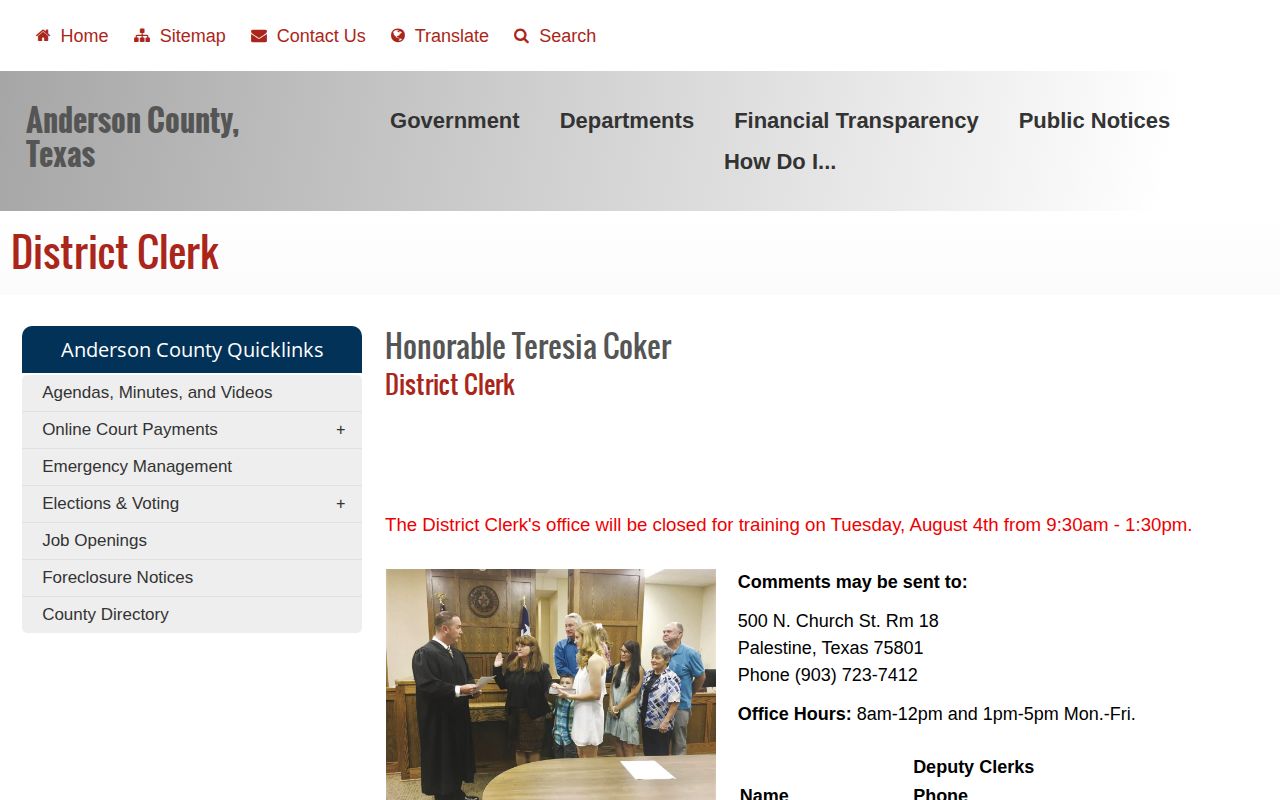
The Anderson County District Clerk page identifies the office that supplies district-court copies and its request process.
The clerk's formal copy can explain the legal event, while the ACSO booking-out record supplies the physical release time. A bond does not end the prosecution; dismissal or acquittal does not necessarily print the jail exit time; commitment to TDCJ indicates continued custody.
Request Anderson Booking-Out Entries
A focused request can ask ACSO to provide all existing booking-out or release entries between two inclusive timestamps, including name, booking number, release date and time, release authority or type, transfer destination, and booking photograph. If only one person matters, identify that person and the known booking. Prefer electronic native-format records when available, and ask for redaction of protected fields rather than withholding of the public remainder.
Texas Government Code Chapter 552 covers existing government information, but juvenile, medical, victim, sealed, expunged, and other confidential material remains restricted. Anderson County publishes no flat release-record or booking-photo fee. Attorney General cost rules apply, including written-estimate procedures in applicable cases above $40. If the question instead concerns a court order, use the correct clerk's copy form and fee schedule rather than sending the judicial-document request to ACSO.
Why Anderson Release History Is Request-Based
The local web gap is distinctive: ACSO makes operational jail PDFs available but offers no public release archive of any duration. The county press-release page may describe a particular investigation, yet it is not a systematic booking-out product. Its publication date cannot prove either current custody or release.
Texas retention requirements are separate from online access. State Library schedule items PS4200-10 and PS4200-12 provide a two-year minimum after release or transfer for specified release and property records. That supports a request for the underlying record but does not create a 72-hour webpage or guarantee that every field is public. The official record should remain the basis for the answer.
Separate Release from a Three-Day Transfer
When an ACSO entry names TDCJ, search the current TDCJ locator by number where possible. The state system includes only currently incarcerated people, updates on working days, and is at least 24 hours old. If the person later drops from that locator, request incarceration history through the TDCJ email information channel. A county departure followed by a state admission is transfer, not discharge.
If ICE is named, use its detainee locator promptly because its released-person coverage extends only 60 days after ICE release. For USMS custody, inspect the federal docket and later BOP status when appropriate. Another county destination requires that county's receiving record. The strongest chain pairs the Anderson booking-out time with receiving admission and a later actual release record.
IVSS Alerts Are Not 72-Hour History
Texas IVSS-Counties replaced VINE in 2025. It provides notifications for booking, release, court events, death, escape, and transfer to TDCJ through telephone, text, or email. Confirm Anderson County in the live county selection because no static authoritative source established participation; the 24-hour support line is 866-268-8959.
A search may stop showing someone after custody ends while a saved registration remains active. That design serves notification, not retrospective date-range research. Read whether an alert says release or transfer, then request the booking-out record. For a single named person across all relevant custody systems, begin with the Anderson County release records guide.
Public Record Search
Sponsored Results