
George Beto Release Outcomes
A person can leave George Beto Unit through several state processes. Parole is conditional community release approved by the Texas Board of Pardons and Paroles, followed by TDCJ Parole Division supervision. Mandatory supervision is a separate statutory release route. Discharge means the sentence and applicable supervision have ended. Transfer means the person remains in custody at another state facility.
These distinctions control where to verify the event. A current TDCJ result with a new unit shows continued state custody. A favorable parole vote is not physical release. Classification and Records must audit the file, and Review and Release Processing checks the plan, conditions, required programs, disciplinary issues, county-of-residence rules, and other release criteria. Only the later scheduled release fields and completed event show the next step.
Search George Beto Custody
The TDCJ Online Inmate Search covers people currently incarcerated in TDCJ facilities. The database is updated on working days, and its information is at least 24 hours old. It does not maintain a public Released or Discharged profile for every former prisoner.
- Enter the seven-digit TDCJ number or SID number when available.
- For a name search, enter the exact last name and at least the first initial.
- Use gender and race only to narrow the result set.
- Compare identifiers, conviction details, and unit location before selecting a match.
- Read Projected Release Date and parole planning fields as prospective, not completed, events.
A same-name result is not enough. Confirm the TDCJ number, county of conviction, offense, and other available identifiers. Save the date on which the search was checked because the public data can lag.
George Beto Historical Records
When a former Beto prisoner no longer appears, use the TDCJ inmate-information email route. Send the full name and seven-digit TDCJ number to pia@tdcj.texas.gov. If the number is unknown, provide the exact date of birth. If that is also unknown, give an approximate age and county of conviction. Put the person's name in the subject.
TDCJ says this no-charge information channel may return the TDCJ number, current location, conviction offense, prior incarceration history, and offense, county, and court details. It can also supply the projected release date for a current sentence. Photographs are not provided through this email channel. For a document outside the channel, make a focused Texas Public Information Act request to TDCJ.
Pair the response with the relevant court judgment. A no-result screenshot shows only that the person was not in the current-only locator when checked. It does not establish the release date, release type, discharge, or transfer history.
George Beto Contact Details
The official unit page supplies the facility identity and contact. Call the unit for current operational information, but use TDCJ records and parole channels for formal release history. Public release-processing hours and a public exit routine were not verified.
1391 FM 3328
Tennessee Colony, TX 75880
Phone: 903-928-2217
Operator: TDCJ Correctional Institutions Division
Beto lies about six miles south of Tennessee Colony on FM 3328. It is an adult male TDCJ prison, not the Anderson County Jail. County sheriff staff do not control its offender search, parole status, state transfer record, or sentence discharge.
George Beto Unit Profile
The official George Beto Unit page reports a capacity of 3,471. It lists G1 through G4 custody, security detention, outside trusty, and transient classifications. Capacity is a facility figure, not an annual release total.
Custody classification describes management within the prison system. It does not predict the release date. A transient classification can also reflect movement within TDCJ rather than a final release.
The official Beto source is shown in the matching facility image below.
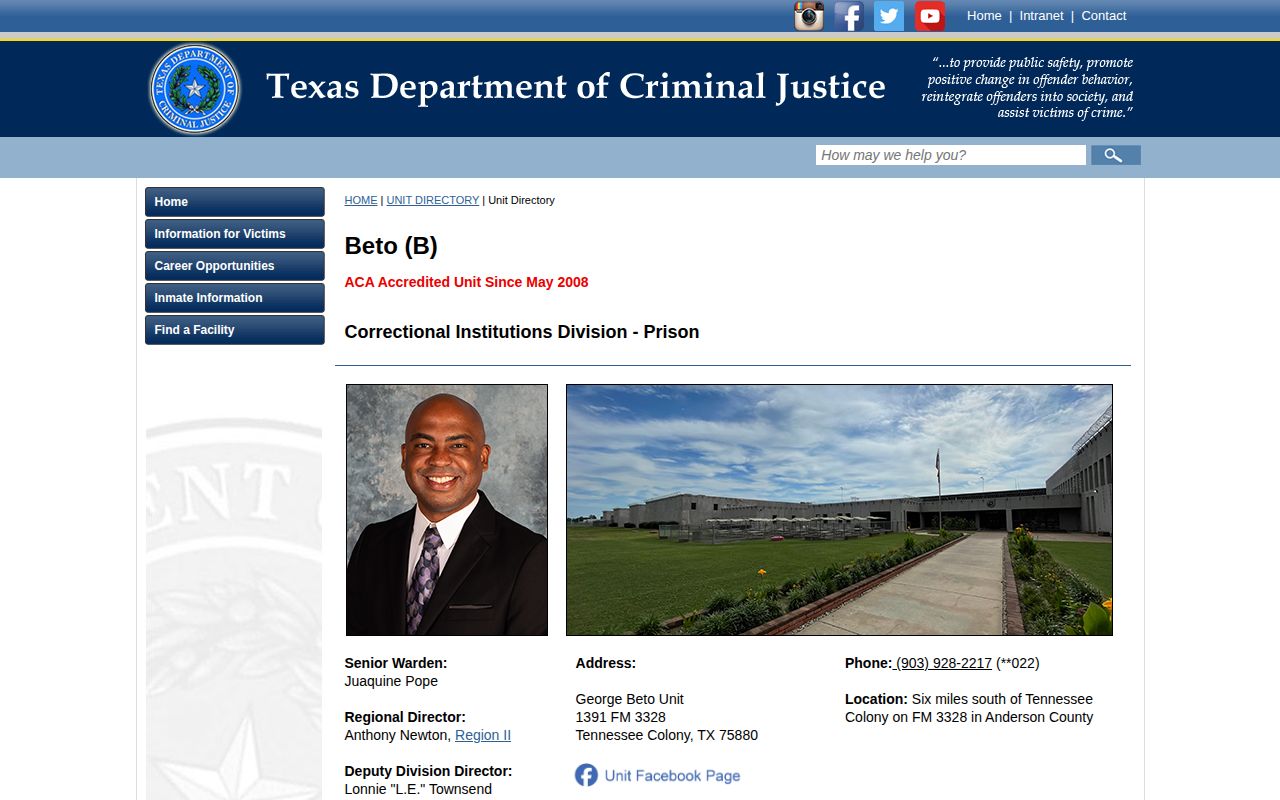
The unit page confirms location, contact, capacity, and prison role, while the offender locator and records channels answer person-specific custody questions.
Beto Projected Release Fields
Projected Release Date is TDCJ's exact prospective label. It is an estimate based on the current record and applicable rules. It can change after sentence calculations, credits, disciplinary action, a new judgment, or a parole decision. It is not the same as a completed release date.
| Field or event | Meaning |
|---|---|
| Projected Release Date | Current estimate, subject to change |
| Parole approval | Board decision, not physical release |
| Scheduled Release Date | Date set after state review and audit |
| Scheduled Release Location | Planned processing location |
| Discharge | Sentence and applicable supervision completed |
TDCJ warns that a scheduled date can change without notice, even on that date. Verify again near the event. If the person remains at Beto after a favorable vote, release planning or another requirement may still be pending.
Beto Parole Confirmation
The Texas Board of Pardons and Paroles decides parole cases. TDCJ Parole Division manages field supervision after release. The Palestine Board Office votes cases from Beto and the four other local prisons, while Anderson County field-supervision routing generally goes through the Athens District Parole Office. These offices serve different roles.
For board review status, TDCJ lists 844-512-0461. After a vote, release status is available through 512-406-5202. Review and Release Processing lists 512-406-5449. The general offender locator numbers are 936-295-6371 and 800-535-0283, Monday through Friday from 8 a.m. to 5 p.m.
Parole is not probation. Probation, formally community supervision, is ordered by a court and handled locally by a CSCD. The Anderson County parole and probation page separates the Board, TDCJ Parole Division, Athens DPO, and Anderson County CSCD routes.
Five-Unit Anderson Complex
Beto is one of five TDCJ facilities sharing an approximately 20,528-acre operational complex in Anderson County. The others are H. H. Coffield Unit, Joe F. Gurney Transfer Facility, Mark W. Michael Unit, and Louis C. Powledge Unit. This concentration can make nearby movement look like release when it is still state custody.
Gurney is specifically a reception and transfer facility. Movement from Gurney to Beto can be a normal placement deeper in TDCJ. A later move from Beto to Coffield, Michael, Powledge, or a facility elsewhere in Texas remains a transfer unless official state records document parole, mandatory supervision, or discharge.
Use the TDCJ unit directory to confirm unit names and codes. Then use the person-specific current locator. Facility pages describe institutions, not the completed status of a named person.
Beto Release Versus Transfer
Build a short evidence chain. First, note the last confirmed Beto result and its date. Second, check for a new current TDCJ location. Third, review parole status if the case was under Board consideration. Fourth, request historical information when the current result disappears. Finally, compare the state answer with the conviction court's judgment.
A detainer can also affect the path. If another authority takes custody after TDCJ, release from state custody does not necessarily mean unrestricted community release. The receiving authority's record controls the next stage. Do not label the event by inference.
The Anderson County released inmate search provides the broader decision route for county, state, federal, and immigration custody. For Beto, TDCJ remains the primary source from incarceration through release processing and historical confirmation.
George Beto Record Review
Keep the TDCJ number with every saved result. Record the search date, unit code, projected date, parole status, and source. If two sources differ, favor the later official record but ask TDCJ to resolve a material conflict.
Texas Government Code Section 552.029 identifies specified TDCJ inmate information, including department photograph, identification information, assigned unit, conviction, judgment, sentence, county, court, possible release dates, and parole information, as information not excluded under the corrections provision. Other confidentiality laws and exceptions can still affect a particular request.
Release data is time-sensitive. A projected date may move, a unit may change, and a favorable vote may still await processing. A final historical response and court judgment create a stronger record than a stale locator capture.
Public Record Search
Sponsored Results