
Anderson Parole Versus Probation
Texas divides supervision among agencies. The Texas Board of Pardons and Paroles votes on parole and discretionary mandatory supervision. The TDCJ Parole Division then supervises a person released under either form. Anderson County probation is different. A criminal court orders community supervision, and the Anderson County Community Supervision and Corrections Department, or CSCD, administers it. CSCD staff are local special-purpose-district employees, not TDCJ parole officers.
The court judgment and custody history reveal which route applies. A TDCJ prisoner may leave a unit on parole or mandatory supervision while the state sentence continues. A person sentenced directly to community supervision reports under the court's terms. Someone can also finish a county-jail term and then begin probation. Do not infer the route from the word “released.” Obtain the judgment, TDCJ action, or release document that names the legal status.
| Feature | Parole | Probation |
|---|---|---|
| Who orders it | Texas Board of Pardons and Paroles | Sentencing court |
| Who supervises | TDCJ Parole Division | Anderson County CSCD |
| What ended | Prison confinement, not necessarily the sentence | Custody may be avoided or end under the judgment |
| Best proof | Board result, TDCJ release record, Parole Division confirmation | Judgment and court docket, then CSCD routing |
- Parole
- Conditional release from prison while the state sentence remains in force.
- Mandatory supervision
- A supervised TDCJ release governed by statute and, for many cases, Board review.
- Community supervision
- Texas's statutory term for court-ordered probation.
- Discharge
- Completion of the sentence or supervision obligation recorded by the responsible authority.
Verify Anderson County Supervision
Begin with the system that last held or sentenced the person. The public TDCJ search includes only people currently incarcerated and can be at least 24 hours old. Its absence of a former prisoner is not a released or discharged profile. For an Anderson County court case, use the official Public Access Case and Court Records portal. A docket can show a judgment placing a person on community supervision, a commitment to TDCJ, or later court action.
- Match the person and case. Use a cause number, TDCJ or SID number, date of birth where permitted, and conviction details rather than a name alone.
- Read the controlling record. Look for a community-supervision judgment, TDCJ commitment, Board vote, release certificate, or discharge entry.
- Choose the correct office. Contact Anderson County CSCD for probation routing or the TDCJ Parole Division for state parole.
- Ask for lawful public verification. Give the identifier and ask whether the office can confirm the status or direct you to the record custodian.
- Pair status with a release record. A supervision record explains what followed, while the jail or TDCJ record establishes when custody ended.
Three Anderson Supervision Offices
Anderson County has an unusual three-office split. The Palestine Board Office votes cases from George Beto, H. H. Coffield, Joe F. Gurney, Mark W. Michael, and Louis C. Powledge units. It is a Board decision office. It is not the routine field-reporting location for an Anderson County releasee.
The TDCJ county-to-parole-office cross-reference assigns Anderson County field-supervision routing to the Athens District Parole Office. Probation goes to Anderson County CSCD in Palestine. This geography prevents a common error: sending a parole supervision question to the nearby Board voting office merely because both are tied to Anderson County.
1670 N. Highway 155, Suite A
Palestine, TX 75803
903-723-1068
Board voting and correspondence for the five local TDCJ units
1645 Enterprise Street
Athens, TX 75751
903-675-6722
Field-supervision routing for Anderson County parole releasees
611 E. Lacy Street
Palestine, TX 75801
903-729-2408
Court-ordered community supervision
The official TDCJ county cross-reference shows how the releasee's county connects to a district parole office.
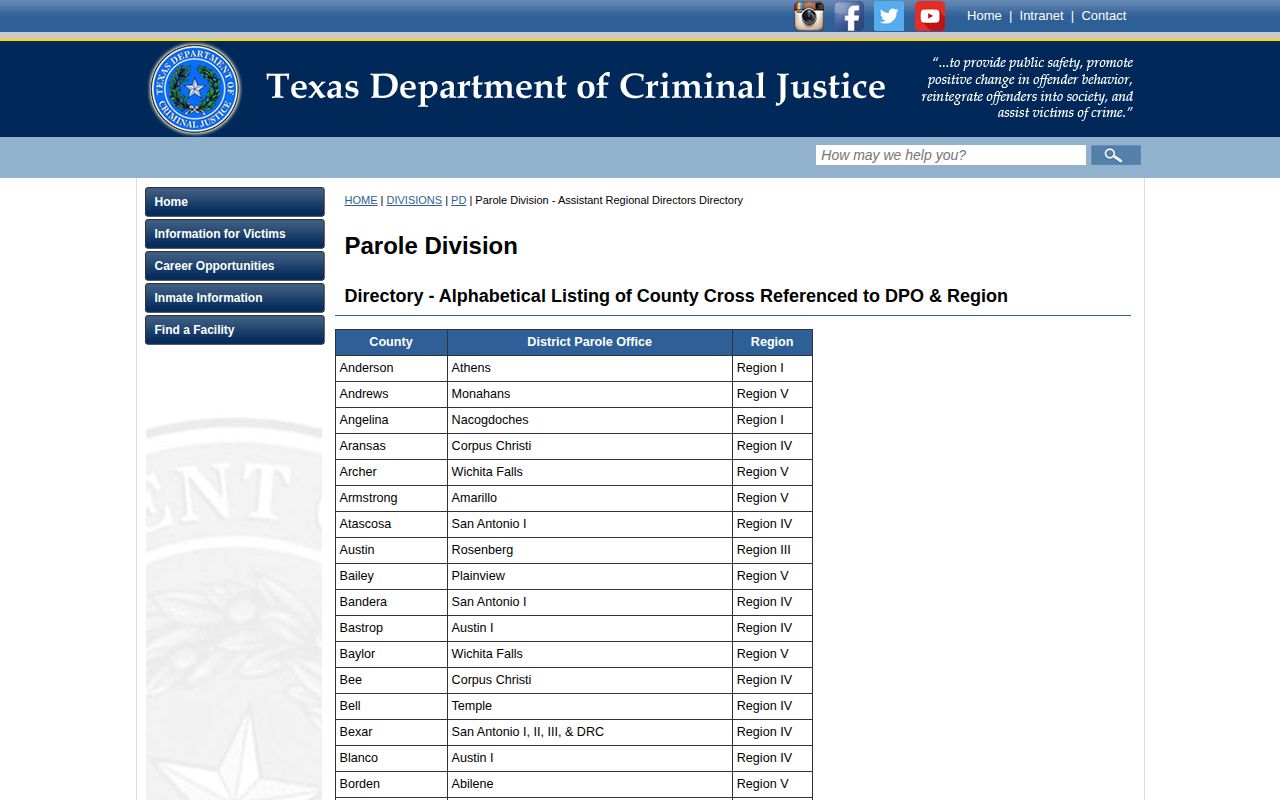
Use the cross-reference for field routing, then verify any reporting instructions on the person's official release paperwork.
Anderson Parole Status Channels
A still-incarcerated person's TDCJ detail may show parole review or release-planning fields. For a person-specific review status, the Board line is 844-512-0461. Have the full name, TDCJ number, and date of birth available. After a favorable action, the Parole Division release-status line is 512-406-5202. These lines answer different stages. The first concerns the Board review; the second concerns release processing after favorable action.
The Board's parole review process explains that file review and panel voting precede any physical release.
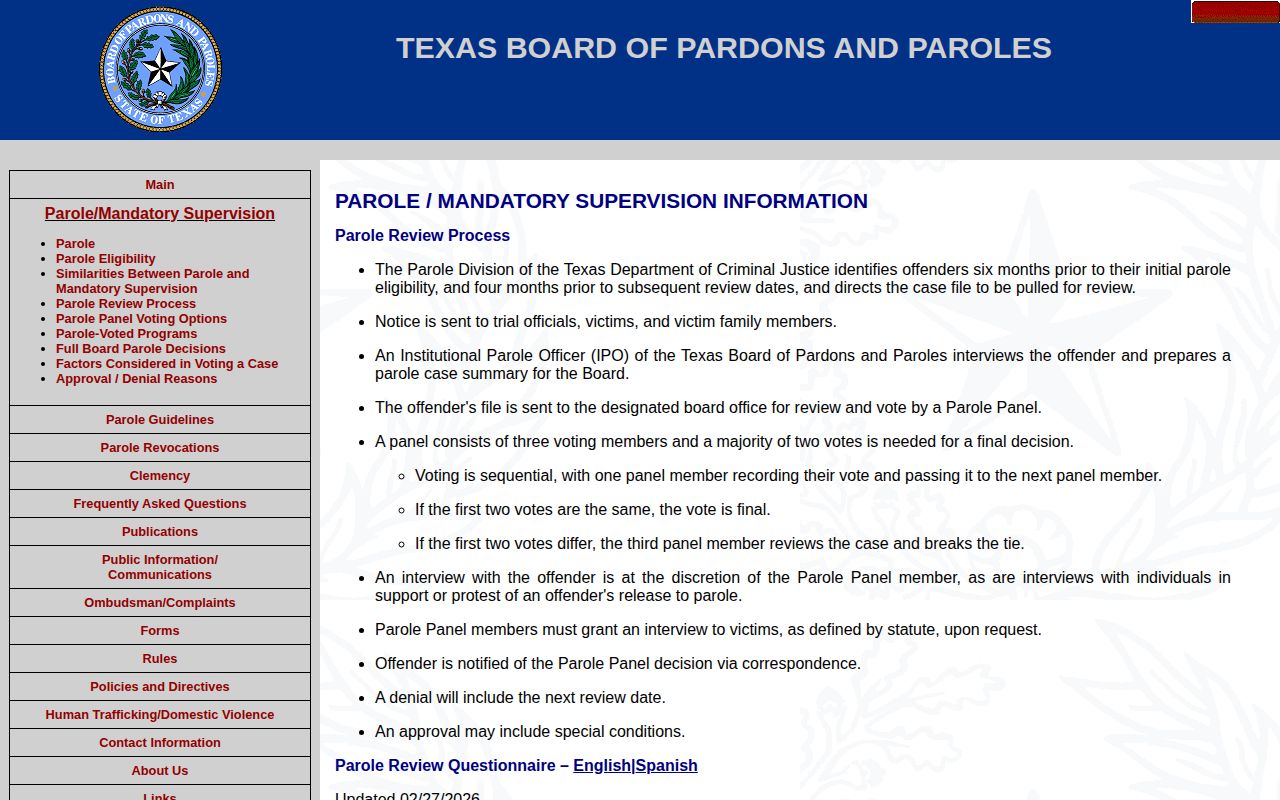
The process image helps separate eligibility, review, a vote, release planning, and the actual day a person leaves a TDCJ unit.
For probation, there is no public statewide name-by-name CSCD locator. Confirm the sentencing court first. Then ask Anderson County CSCD for its lawful public verification method. Do not expect case-management notes, private contact details, or protected data. A certified judgment is stronger proof of the court order than a phone summary.
Anderson Supervision Violations
Release conditions vary by the controlling order. They may include reporting, travel limits, treatment, program completion, fees, or other person-specific terms. Only the release certificate, court judgment, and supervising office can establish the actual conditions. General descriptions cannot substitute for those documents.
An absconder is a supervised person alleged to have stopped reporting or otherwise left supervision without authorization. It does not mean that the public can search NCIC or TCIC. Those law-enforcement databases are not open public name indexes. The Board explains that an officer reports alleged parole violations, a warrant may follow probable-cause review, and the sheriff notifies Parole Division after detention. No official statewide public parole-absconder database was found.
Use the court, supervising office, and lawful local warrant channels. Texas IVSS notifications can flag certain custody changes, but an alert is not a certified supervision record. County IVSS and TDCJ IVSS are separate services. A county transfer-to-TDCJ event may require a later TDCJ notification registration.
Note: A custody alert may describe transfer, booking, escape, or release, so read the event text before drawing a conclusion.
Anderson Release Records Stay Offline
Anderson County has no public release archive, yet offline records may remain available. The Texas public-safety retention schedule places booking-out, release, transfer, classification, and related court release documents under item PS4200-10. The minimum is release or transfer plus two years. Property inventories and receipts under PS4200-12 carry the same minimum.
That schedule does not promise two years of web access. It supports a focused request to the custodian. Ask ACSO for booking-in and booking-out times, release type or authority, court reference, and receiving agency if the person transferred. Then obtain the court or TDCJ record that explains supervision. Expunction, nondisclosure, juvenile rules, and other confidentiality laws can limit disclosure.
Anderson Reentry After Supervision Begins
The official TDCJ Reentry Resource Guide contains an Anderson County block for identification documents, food resources, mental-health care, and substance-use support. These entries can help after a TDCJ release, but listings and hours can change. Call the provider before traveling and use the current release paperwork for any supervision appointment.
Identification needs can be urgent because a person may need records from the Texas Department of Public Safety or Social Security Administration. A release certificate, discharge paper, birth record, or other document may be needed depending on the agency. The guide is a referral source, not proof that a service is open or that a person qualifies.
A supervised releasee should distinguish service navigation from supervision compliance. Athens DPO or Anderson County CSCD controls reporting duties. Community providers address separate needs. If the written terms and a verbal instruction conflict, contact the assigned office promptly and preserve the written response.
The reentry guide also helps readers sort a practical need from an official record question. A food pantry or treatment provider cannot verify parole status, and a parole office is not the custodian of an Anderson County jail booking photo. Keep the release certificate, court judgment, identification papers, and contact notes together. When an office redirects the question, record the date, staff unit, and next custodian. That simple chain reduces repeated calls and keeps the supervision record tied to the correct person.
When Anderson Supervision Ends
Parole or mandatory supervision ends when TDCJ records the applicable discharge or other lawful termination. Release from the prison gate is earlier and does not itself complete the sentence. TDCJ defines discharge as completion of the sentence and release from incarceration, parole, mandatory supervision, or community supervision. Request historical incarceration information when a former prisoner no longer appears in the current locator.
Probation ends under the sentencing court's order and record. Completion, early termination, revocation, or modification must be read from the docket and signed orders. A no-result in a custody search cannot prove successful completion. The Anderson County released-inmate search workflow on the home page explains how to pair booking-out evidence with the court or corrections record.
For documentary confirmation, request the specific final order or agency history rather than a broad statement that the person is “off paper.” That informal phrase can hide several different outcomes. The court may have entered a discharge order, TDCJ may have reached sentence expiration, or jurisdiction may have shifted after a new custody event. The official record should name the authority, effective date, and disposition. Verify those fields against the same identifiers used at the start of the search.