
Understanding Anderson County Released Inmates
A release is the end of one specific custody event. At the Anderson County Jail, that may mean bond, a court order, dismissal, time served, sentence completion, or transfer. At one of the five local Texas Department of Criminal Justice units, it may mean parole, mandatory supervision, full discharge, or movement to another prison. The word alone does not prove that a person is free from every authority.
The agency that ended custody keeps the key record. Anderson County Sheriff's Office controls its booking-out documentation. A county or district court supplies the order or case outcome behind many jail releases. TDCJ controls state-prison classification, parole planning, and discharge information. BOP and ICE maintain separate federal systems. Matching the record system to the confinement prevents the most common false conclusion: treating a transfer as community release.
How Anderson County Custody Ends
The booking-out reason determines where to check next. Court records help explain bond and judicial orders, while the receiving agency becomes the source after a transfer. A state unit departure requires TDCJ confirmation rather than a county jail inquiry.
| Departure type | Meaning | Next source |
|---|---|---|
| Bond or court order | The local booking ends while the case may continue. | ACSO record and criminal court portal |
| Time served or completion | The jail portion of a sentence ends. | Booking-out record and judgment |
| TDCJ transfer | County custody ends, but state confinement begins. | TDCJ current locator |
| Parole or mandatory supervision | A state prisoner enters supervised community release. | TDCJ and Parole Division |
| Sentence discharge | The state sentence and connected supervision end. | TDCJ historical information |
| ICE, USMS, or another county | Another authority receives the person. | Receiving agency and county transfer record |
Note: A missing name from a current roster shows only that the person is not listed there now.
What an Anderson County Release Record Shows
Anderson County has no single public release certificate. The most useful county document is the jail booking-out or release entry tied to the arrest. It should be read beside the court docket when a judicial action caused release. Ask for fields that distinguish a return to the community from a handoff to another authority.
| Field | What it shows |
|---|---|
| Name and identifiers | The person attached to the booking. |
| Booking number | The jail event that ended. |
| Booking-in and booking-out time | The measured span of that custody event. |
| Charges and arresting agency | The basis recorded at booking. |
| Bond type and amount | Bond data kept with the booking, when recorded. |
| Release type or authority | The administrative or judicial basis for departure. |
| Court or cause number | The link to the related court file. |
| Destination or receiving agency | Whether the event was a transfer rather than community release. |
A court disposition is complementary. It may show dismissal, plea, conviction, jail credit, sentence, or community supervision, but it may not give the jail's exact door-out time. Likewise, a booking-out entry may identify an order without explaining the whole case.
Requesting Anderson County Booking-Out Records
Because the sheriff publishes no roster or release archive, a narrow public-information request is the durable route. The Texas Public Information Act applies to existing government records. It does not require an office to create a new report, so wording the request around existing booking fields matters.
- Identify the person by full name, booking number if known, and a narrow arrest or booking date range.
- Send the request to Anderson County Sheriff's Office at 1200 E. Lacy Street, Palestine, Texas 75801, or call 903-729-6068 to confirm the current submission channel.
- Ask for booking-in and booking-out dates and times, charges at booking, bond data, release type or authority, court reference, receiving agency, and booking photograph.
- Request electronic copies and ask for public portions with protected material redacted instead of withholding the whole record where law permits.
- Compare the response with the official Anderson County criminal court portal and contact the receiving authority when a transfer is listed.
Texas retention schedule PS4200-10 keeps booking-out and release records for at least release or transfer plus two years. Property receipts under PS4200-12 have the same minimum. That retention rule does not create an online archive, but it explains why a written request can still work after a name disappears from a live system.
Texas Law and Anderson County Release Records
Texas Government Code Chapter 552 supplies the public-information framework. Access remains subject to law-enforcement exceptions, juvenile confidentiality, privacy protections, victim information, sealing, expunction, and nondisclosure. A requester can seek segregable public material and permit lawful redaction.
Current expunction law appears in Code of Criminal Procedure Chapter 55A, while Government Code Chapter 411 addresses orders of nondisclosure. Neither a release nor an old online result automatically means that the underlying case was cleared. The order and the issuing court control. Juvenile information must follow its restricted process and should never be treated as an adult release search.
Anderson County Property and Identification After Release
Property return can provide a separate paper trail when the booking-out record is sparse. Texas Schedule PS requires sheriff property receipts to be retained for at least two years after release or transfer. A person seeking a missing receipt should identify the booking and ask ACSO about the record rather than assume the property was released with the person.
The TDCJ reentry guide lists local identification contacts, including the DPS office at 1900 W. Spring in Palestine and Social Security at 215 Medical Drive. These are practical starting points for replacing documents after state custody. Current hours should be confirmed because the guide can age. Identification services do not prove the release itself.
How to Find Anderson County Released Inmates
A useful search moves from the last known facility outward. The county does not publish a recent-release feed, and the TDCJ web search is current-only. Absence from either system is therefore a clue, not the final record.
- Identify whether the last known location was Anderson County Jail, a local TDCJ unit, another county, federal custody, or immigration custody.
- For the county jail, call ACSO and request the booking-out entry. Then search the official criminal court portal for the order or disposition.
- For Beto, Coffield, Gurney, Michael, or Powledge, search the TDCJ locator first. If no current result appears, use TDCJ's historical information request channel.
- Check parole or probation only when the disposition suggests supervision. The Athens District Parole Office and Anderson County CSCD serve different functions.
- Use BOP or ICE only when the county record names a federal or immigration handoff.
- Reconcile names, identifying numbers, dates, and destination before treating the event as community release.
For same-day checks, the Anderson County 24-hour release guide explains the exact fallback. It is not a substitute for the booking-out record.
TDCJ Offender Search for Anderson County Releases
The TDCJ Online Inmate Search covers people currently incarcerated by TDCJ. It accepts an exact last name with at least a first initial, a seven-digit TDCJ number, or a SID number. Gender and race can narrow the result. A current record may show the unit, offenses, projected release date, and parole review or release-planning details.
| Search input | Use |
|---|---|
| Last and first name | Exact last name plus at least a first initial is required. |
| TDCJ number | Seven-digit state identifier for a direct match. |
| SID number | Texas criminal-history identifier. |
| Gender and race | Optional filters for similar names. |
A former prisoner does not retain a public Released or Discharged profile in this current-only search. Email TDCJ offender information at pia@tdcj.texas.gov with the full name and TDCJ number. If the number is unknown, add the exact birth date or an approximate age and county of conviction. That no-charge route may return prior incarceration history and projected release information, but not a photograph.
The official TDCJ request page shows the historical-information route and its limits.
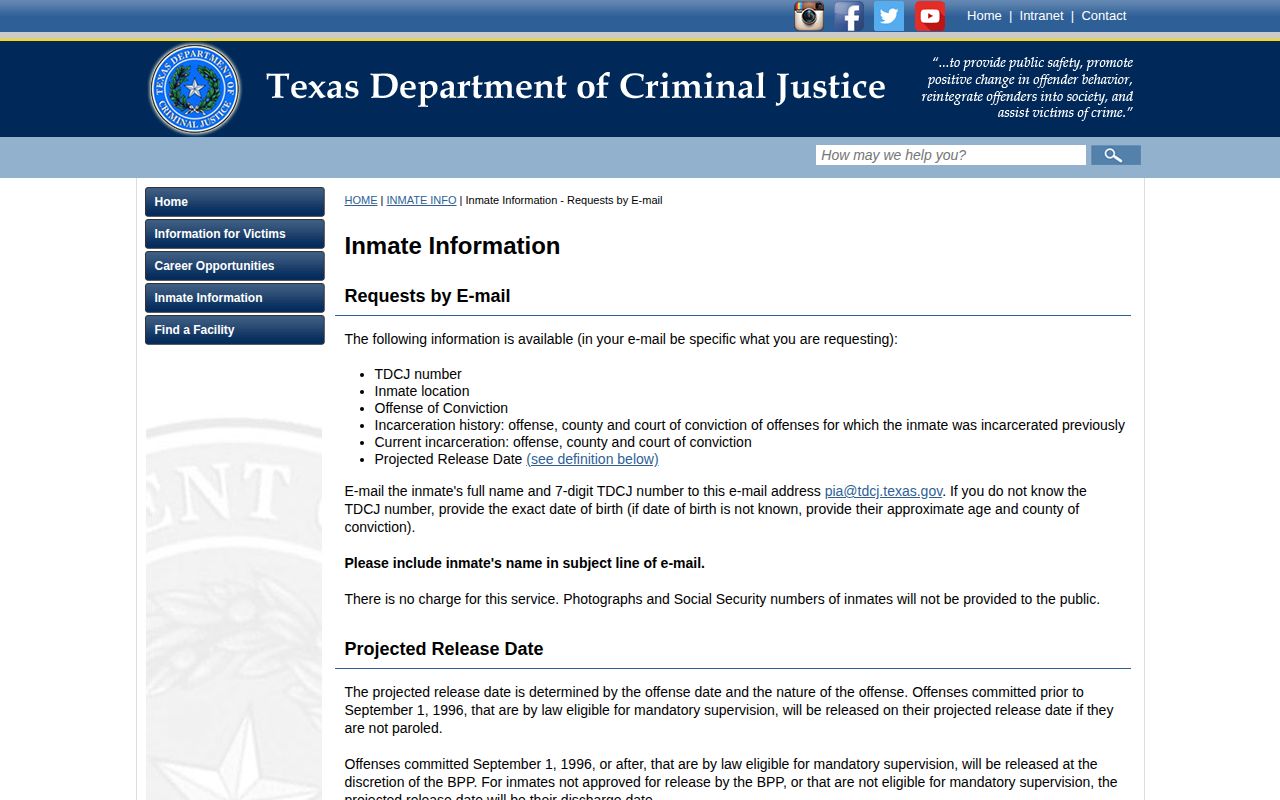
Use the displayed agency instructions when a current locator search no longer returns the person.
Choosing the Anderson County Court Search
Anderson County links to more than one records interface, and they do different jobs. The official Tyler Technologies Public Access portal is the route for criminal case and court records. It can provide the case history behind a bond, dismissal, sentence, or court-ordered release.
The County Clerk's publicsearch.us interface focuses on recorded instruments. It is not the main criminal case lookup. Searching the wrong portal can yield no result even when a criminal case exists. Start with the county's official court access link, match the cause number from the booking record, and contact the District Clerk or County Clerk according to the court that holds the case.
Anderson County's Five-Unit Prison Complex
Anderson County's custody map is unusual. Alongside its county jail are five TDCJ institutions: George Beto, H. H. Coffield, Joe F. Gurney, Mark W. Michael, and Louis C. Powledge. Official unit materials describe cooperative operations across about 20,528 acres. A search that uses only the sheriff can miss a state prisoner located in the same county.
Gurney requires special care because it is a reception and transfer facility. Leaving Gurney commonly means movement deeper into TDCJ, not release. A new unit in the state locator confirms continued custody. A no-result requires historical TDCJ confirmation; it does not reveal why the record disappeared.
Anderson County Parole and Probation Checks
Parole decisions for the five local prisons route through the Palestine Board Office, while field supervision for Anderson County releasees routes through the Athens District Parole Office. Probation is administered separately by Anderson County Community Supervision and Corrections Department at 611 E. Lacy Street.
A parole vote is not the same as physical release. TDCJ still audits the record, approves a release plan, and produces a scheduled release date and location. Probation usually follows a court judgment rather than release by the parole board. The Anderson County parole and probation guide shows which office verifies each status.
Anderson County Notifications and Federal Release Checks
Texas replaced county VINE with IVSS-Counties on September 1, 2025. That portal searches participating county custody and supports email, text, telephone, or TTY alerts. A person may disappear from its search when custody ends while the saved registration remains active. Treat an alert as notice and obtain the ACSO record for certified booking-out facts.
TDCJ maintains a separate IVSS for prison and parole notifications. BOP's inmate locator covers federal custody and can display RELEASED with a release date; UNKNOWN means the term is undetermined, and IN TRANSIT is not release. No federal prison is verified within Anderson County, so this path matters only when another record points to federal custody.
When Anderson County Release Means an ICE Transfer
A person leaving ACSO under an immigration detainer has left the county booking but has not necessarily entered the community. Ask the booking-out record to name the receiving authority. Then use the ICE Online Detainee Locator with either a nine-digit A-number and country of birth or exact name and biographical details.
ICE includes people released from its custody only for the preceding 60 days, and it excludes minors. That short window makes the county transfer record important. It establishes where the local custody ended; ICE supplies the later immigration-custody status.
Released or Still Held in Anderson County
Each system answers a narrow custody question. Comparing their scope keeps a live no-result from being treated as a historical conclusion.
| Source | Best use | Main limit |
|---|---|---|
| ACSO booking-out record | Exact end of a county booking and receiving authority | Not published as an online feed |
| Anderson criminal court portal | Order, disposition, sentence, and cause history | May not show door-out time |
| TDCJ locator | Current state prisoner, unit, and projected date | Former prisoners disappear |
| TDCJ records | Prior incarceration and state release history | Requires identifying details |
| BOP locator | Federal status and released result | Federal custody only |
| ICE ODLS | Immigration custody and recent ICE release | Released results last only 60 days |
Anderson County Services After State Release
The official TDCJ reentry guide includes a specific Anderson County block. Purpose-neutral entries include ACCESS mental-health services in Jacksonville, the Palestine Community Food Pantry at 1434 Court Drive, the DPS identification office in Palestine, and the local Social Security office. The guide also provides crisis and substance-use navigation.
These services can help with immediate documents, food, or health needs after release. They do not confirm custody status. Check present hours and eligibility directly because directory information can change, then use the agency record for proof of release.
Anderson County Release Facilities
The county jail handles adult local bookings, while the juvenile department uses confidential authorized channels. The remaining facilities are TDCJ prisons or a state transfer unit. Each page follows the correct release route.
- Anderson County Jail: ACSO booking-out record and court case.
- Anderson County Juvenile Probation Department: restricted department and court process.
- George Beto Unit (B): TDCJ locator, parole, and state records.
- H. H. Coffield Unit (CO): TDCJ movement or release confirmation.
- Joe F. Gurney Transfer Facility (ND): transfer-first state routing.
- Mark W. Michael Unit (MI): TDCJ parole, mandatory supervision, discharge, or transfer.
- Louis C. Powledge Unit (B2): statewide TDCJ release records.
Public Record Search
Sponsored Results