
Gurney Transfer or Release
Gurney's name describes its central role. It receives and processes men moving through TDCJ. A person can leave after classification and placement at Beto, Coffield, Michael, Powledge, or another Texas unit. That movement is continued incarceration, even though the Gurney location has ended.
A true community release can occur through parole or mandatory supervision. Parole remains conditional supervision for the balance of the sentence. Discharge is different: TDCJ defines Discharge Date as completion of the sentence and release from incarceration, parole, mandatory supervision, or community supervision. A favorable Board vote alone is not a completed release because records auditing and release planning remain.
Locate the Receiving Unit
Search the TDCJ Online Inmate Search, which covers people currently incarcerated by TDCJ. TDCJ updates it on working days and says the information is at least 24 hours old. The locator does not preserve a public Released or Discharged page for every former prisoner.
- Enter the seven-digit TDCJ number or SID number for the strongest match.
- If searching by name, use the exact last name and at least the first initial.
- Narrow with gender and race only when needed.
- Compare conviction county, offense, identifiers, and unit before choosing a record.
- Treat a different unit as continued custody, not as evidence of release.
A Gurney result means the person is currently assigned there as of the data date. A Beto or Coffield result means the transfer chain continued. A no-result can reflect spelling, lag, or departure from current TDCJ custody, but it supplies neither the date nor reason.
Request Gurney History
When the current locator cannot answer what happened, use the TDCJ inmate-information email channel. Email pia@tdcj.texas.gov with the full name and seven-digit TDCJ number and put the name in the subject. If the number is unknown, provide exact date of birth; if that is unavailable, give approximate age and county of conviction.
TDCJ says the no-charge response may provide the TDCJ number, current location, conviction offense, prior incarceration history, and offense, court, and county details. It can provide a projected date for a current sentence. The channel does not provide photographs. Request a specific existing document through the Texas Public Information Act when the standard information response does not cover the needed release, discharge, or transfer record.
The Anderson County Sheriff's Office is not the records custodian for Gurney. Likewise, an Anderson County court portal may not cover a sentence imposed in another county. Use the TDCJ identifier to connect the state history with the correct conviction judgment.
Joe F. Gurney Contact
The unit can answer current operational questions, but person-specific release history should be verified with TDCJ records and parole offices. No public release-processing hours or public exit routine were verified in the research.
1385 FM 3328
Palestine, TX 75803
Phone: 903-928-3118
Operator: TDCJ Correctional Institutions Division
Gurney is an adult male state transfer facility, not a county booking jail. Its Palestine mailing address does not place its records under the sheriff or make the Anderson County recent-release process applicable.
Gurney Facility Profile
The official Gurney facility page reports capacity of 1,130 and G1 through G3 and transient custody. The transient classification fits the facility's reception and transfer purpose.
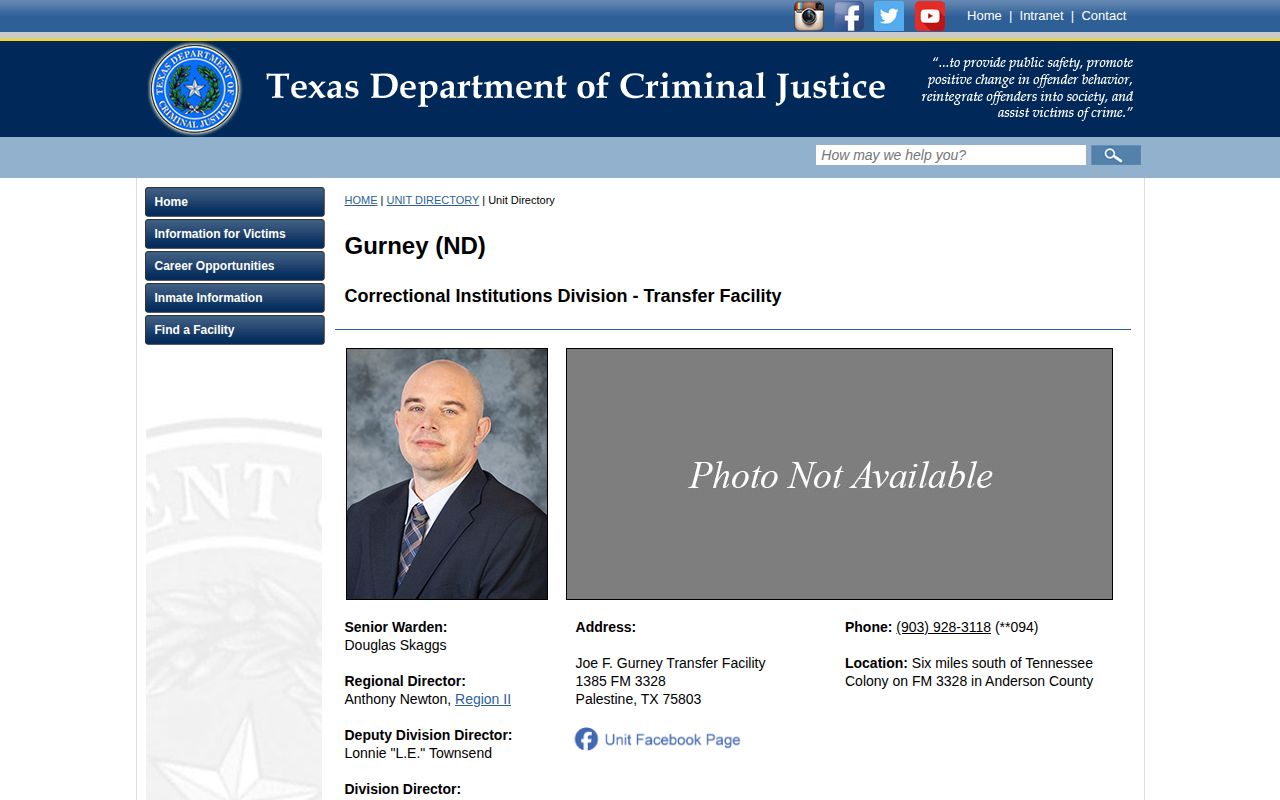
The official page confirms the address, contact, capacity, and transfer role. It does not report whether a named person completed transfer, entered supervision, or discharged.
Capacity is not a release count, and custody classification is not a date forecast. A transient label supports the need to check for later placement rather than assume a final outcome.
How Gurney Movement Works
The TDCJ unit directory gives a broader view of the state units among which a person may move.
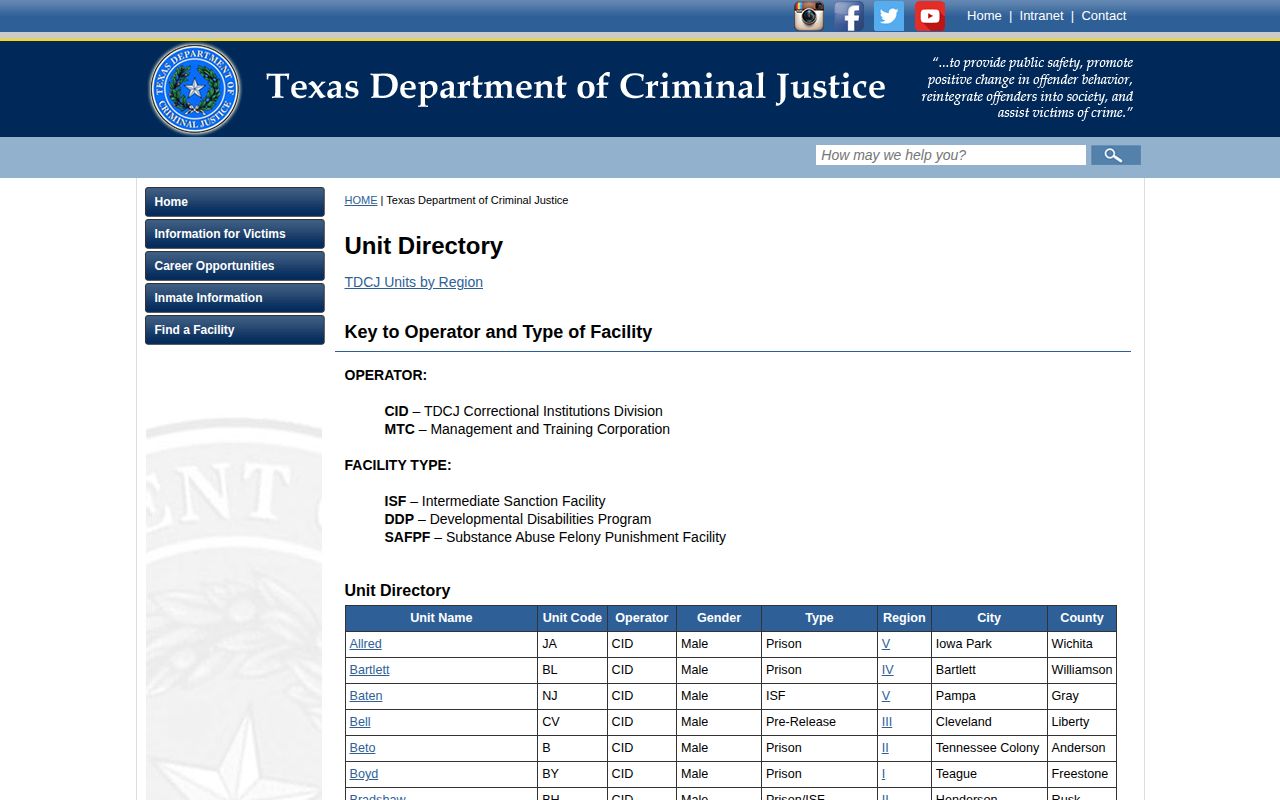
The directory helps decode a new unit name or code after Gurney, while the offender locator supplies the person-specific current location.
Why can a Gurney result change quickly? Reception and transfer are core functions rather than proof of imminent community release. A later unit is the next documented stage of state custody unless TDCJ records identify parole, mandatory supervision, discharge, or transfer to another authority.
Interpret Gurney Date Fields
Projected Release Date is a prospective calculation, not the date someone leaves Gurney. It can change with sentence calculations, credits, disciplinary events, later judgments, or parole decisions. Scheduled Release Date follows favorable action and state audit, but TDCJ cautions that it can change without notice, including on that date.
| Result | Correct interpretation |
|---|---|
| New TDCJ unit | Transfer completed; state incarceration continues |
| Projected Release Date | Current estimate, not completed departure |
| Favorable parole vote | Decision made; processing may remain |
| Scheduled Release Date | Planned event after review and audit |
| Discharge Date | Sentence and applicable supervision completed |
Preserve TDCJ's exact label whenever saving or describing a date. A move from Gurney can occur long before the projected date and does not alter its prospective character.
Parole Routing After Gurney
The Texas Board of Pardons and Paroles makes parole decisions. The TDCJ Parole Division handles supervision after release. The Palestine Board Office is assigned cases from Gurney and the four other local prisons, but it is not the routine field reporting office. Anderson County supervision routing generally goes through the Athens District Parole Office.
For Board review status, TDCJ lists 844-512-0461. After a vote, release status is available at 512-406-5202, while Review and Release Processing lists 512-406-5449. General offender locator help is available at 936-295-6371 or 800-535-0283 on weekdays from 8 a.m. to 5 p.m.
Probation is court-ordered community supervision and belongs to a CSCD, not the Board. The Anderson County parole and probation page explains the local office split.
Anderson County Prison Cluster
Gurney sits within an unusually large local state-prison concentration. Five TDCJ facilities share an approximately 20,528-acre operational complex: Gurney, George Beto Unit, H. H. Coffield Unit, Mark W. Michael Unit, and Louis C. Powledge Unit. Nearby movement among them may be ordinary classification and placement, not a release from Texas custody.
This distinctive arrangement also explains why geographic clues can mislead. A person may remain in Anderson County after transfer, or travel to a TDCJ unit elsewhere in Texas. Neither distance nor a changed unit name determines parole or discharge. State identifiers and state records do.
The Anderson County released-inmate guide separates TDCJ events from county-jail booking-out records and receiving-authority transfers. For Gurney, begin with the state route every time.
Document the Final Outcome
Create a chronological evidence chain: last confirmed Gurney result, first confirmed receiving-unit result, any Board decision, the scheduled event if one exists, and the later historical response. Include access dates and the TDCJ number. This method distinguishes an ordinary transfer from parole, mandatory supervision, full discharge, or custody accepted by another authority.
A detainer can mean that leaving TDCJ leads directly to federal, immigration, county, or another custody. In that case, TDCJ departure is not necessarily unrestricted community release. Follow the receiving record and do not infer the result from absence in one locator.
A current-search screenshot is time-sensitive and cannot substitute for durable documentary confirmation. Use TDCJ history and the conviction judgment when precision matters. Public records can establish custody status and legal events; they should not be presented as a way to determine a person's private movements after community release.
Public Record Search
Sponsored Results